

Blockchain App Development vs Traditional Mobile App Development
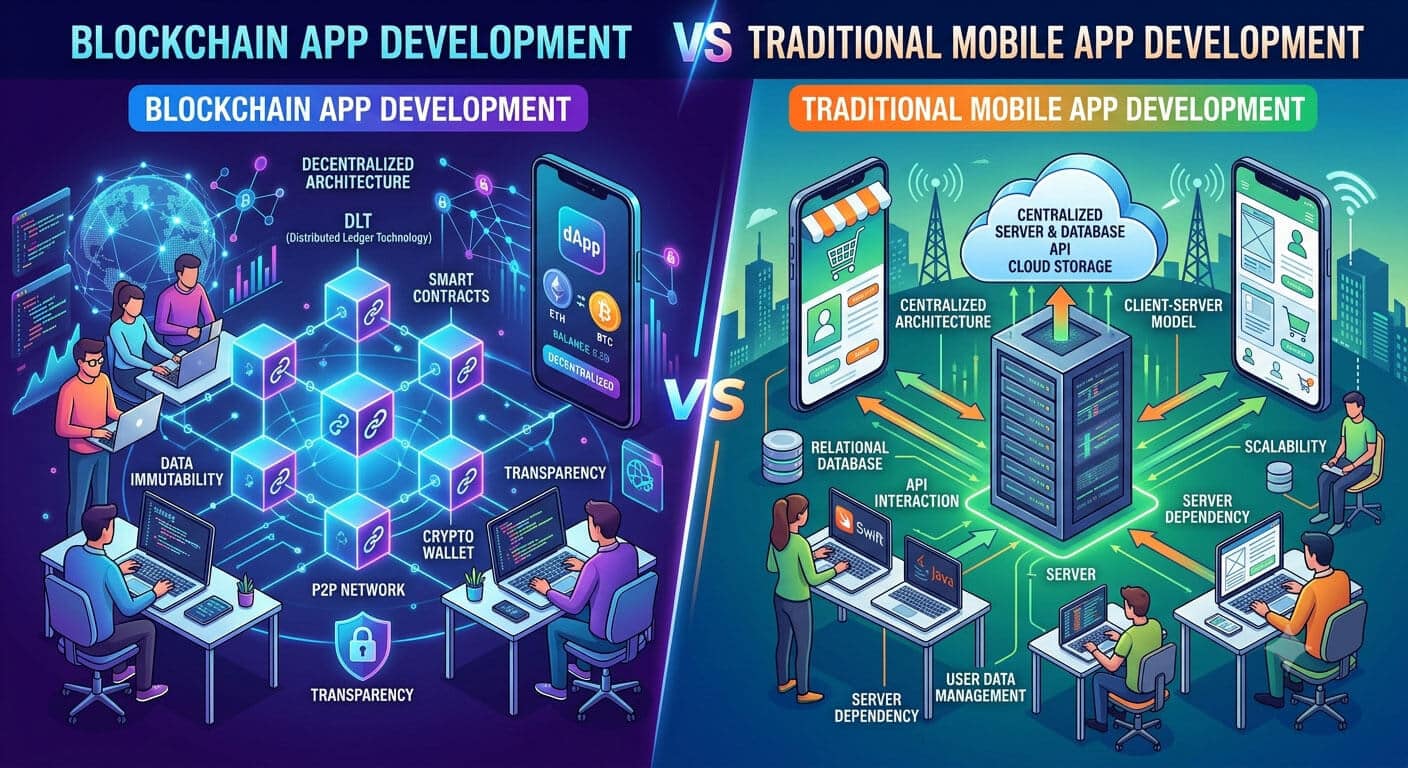
Mobile applications have become an essential part of modern business strategies, helping companies engage customers, streamline operations, and deliver digital services. However, the technology behind an app can vary significantly depending on its purpose. Traditional mobile applications typically rely on centralized servers and databases, while blockchain-based applications use decentralized networks to manage transactions and data.
Understanding the difference between these two approaches can help businesses choose the right technology for their products. This article compares blockchain app development with traditional mobile app development, covering architecture, security, performance, costs, use cases, and development considerations.
What Is Traditional Mobile App Development?
Traditional mobile app development involves building applications for platforms such as Android and iOS using centralized technologies. The app usually communicates with a backend server, which manages user accounts, application logic, databases, and other resources.
For example, an eCommerce application may store product information, customer profiles, orders, and payment records in a centralized database. Users interact with the application through a mobile interface, while the backend processes requests and manages the data.
Businesses commonly use custom mobile app development services to create applications tailored to specific operational and customer requirements. These services can cover UI/UX design, mobile development, backend development, API integration, testing, deployment, and ongoing maintenance.
What Is Blockchain App Development?
Blockchain app development involves creating applications that use blockchain networks to store, verify, or exchange information. Instead of relying entirely on a centralized database, blockchain applications can distribute data across multiple network participants.
Blockchain apps may use smart contracts to automate business rules and transactions. Depending on the project, developers may integrate wallets, digital assets, decentralized identity, tokenization, or cryptocurrency functionality.
Businesses that require decentralized data management or blockchain-based transactions may work with providers offering blockchain application development services. These services can include smart contract development, decentralized application (dApp) development, wallet integration, token development, blockchain integration, and security testing.
Key Differences Between Blockchain and Traditional Mobile Apps
1. Application Architecture
Traditional mobile applications generally follow a centralized architecture. The mobile application communicates with backend servers through APIs, while databases store and manage application data.
Blockchain applications can use a hybrid or decentralized architecture. Some components, such as user interfaces and conventional databases, may remain centralized, while transactions or critical records are processed on a blockchain network.
This makes blockchain architecture more complex because developers need to consider blockchain networks, smart contracts, wallets, nodes, and transaction mechanisms.
2. Data Management
In traditional apps, businesses usually have direct control over their databases. Administrators can update, modify, or delete records according to application requirements and access permissions.
Blockchain networks are designed to provide tamper-resistant records. Once a transaction is confirmed and recorded, changing historical data can be difficult or impossible depending on the blockchain design.
This characteristic can be useful for applications that require verifiable transaction histories, asset ownership records, or transparent activity logs.
3. Security
Security is important for both traditional and blockchain applications, but the risks are different.
Traditional applications need protection against issues such as unauthorized access, SQL injection, API vulnerabilities, data breaches, and server attacks. Developers typically use authentication, encryption, access controls, and secure APIs to protect application infrastructure.
Blockchain applications introduce additional security considerations. Smart contracts, wallet management, private keys, transaction signing, and blockchain integrations all require careful implementation. A vulnerability in a smart contract can potentially affect blockchain transactions directly.
Therefore, blockchain projects often require specialized security audits in addition to standard mobile application security practices.
4. Performance and Scalability
Traditional mobile apps can generally process large numbers of requests by scaling backend infrastructure. Businesses can add servers, optimize databases, use caching, and employ cloud services to improve performance.
Blockchain applications may face network-specific limitations. Transactions can require confirmation from the blockchain network, and transaction speeds can vary depending on the blockchain being used and its current network conditions.
For this reason, blockchain is not automatically the best choice for every mobile application. Developers must determine which functions genuinely require blockchain technology and which can remain off-chain.
5. User Experience
Traditional mobile applications can provide relatively straightforward user experiences. Users typically create an account, log in, and interact with the application using familiar interfaces.
Blockchain applications may introduce additional steps, particularly when users interact with wallets or digital assets. Users may need to connect a wallet, approve transactions, manage private keys, or pay network fees.
Developers therefore need to focus heavily on simplifying blockchain interactions without compromising security.
Cost of Development
The development cost of both application types depends on features, platforms, design complexity, integrations, development location, and maintenance requirements.
Traditional applications may have predictable infrastructure and development costs because they use established technologies and centralized hosting environments.
Blockchain applications can involve additional expenses related to smart contract development, blockchain infrastructure, wallet integration, security audits, token functionality, and network transaction costs.
However, the actual cost depends on the project’s requirements rather than simply whether blockchain technology is used.
When Should You Choose Traditional Mobile App Development?
Traditional mobile development can be suitable when an application primarily requires centralized data management and conventional business functionality.
Common examples include:
- Food delivery applications
- Fitness and wellness apps
- Booking platforms
- Social networking applications
- Retail and eCommerce apps
- Employee management applications
- On-demand service platforms
For these applications, a centralized architecture can provide the performance, flexibility, and management capabilities required by the business.
When Should You Choose Blockchain App Development?
Blockchain can be considered when decentralization, transaction transparency, digital ownership, or tamper-resistant records are important requirements.
Potential use cases include:
- Cryptocurrency wallets
- Decentralized finance applications
- NFT marketplaces
- Tokenization platforms
- Supply chain tracking
- Digital identity solutions
- Blockchain-based payment applications
- Carbon credit trading platforms
- Decentralized marketplaces
The key is to identify whether blockchain provides a meaningful business advantage rather than adding it simply because it is a popular technology.
Blockchain vs Traditional Mobile App Development: Which One Is Right?
There is no universal solution between blockchain and traditional mobile app development. The appropriate approach depends on the application’s objectives, users, data requirements, security model, transaction volume, and budget.
Traditional applications offer mature infrastructure, flexible data management, and efficient centralized processing. Blockchain applications can provide decentralization, verifiable transactions, and digital ownership capabilities but may require additional technical expertise and infrastructure.
Businesses should begin by defining their functional and technical requirements before selecting an architecture. In some cases, a hybrid application can be an effective approach, combining traditional mobile technologies with blockchain components where decentralization or blockchain-based transactions provide clear value.
Ultimately, the technology should support the business objective rather than determine it. A detailed technical assessment can help identify whether conventional mobile development, blockchain technology, or a combination of both is appropriate for the project.
