
7 Home Decor Ecommerce Trends Shaping Online Stores in 2026
Home decor has become one of the fastest-evolving corners of ecommerce. Shoppers who once insisted on seeing a sofa or rug in person before buying now happily order big-ticket pieces online, but only from stores that have closed the confidence gap the showroom used to fill. That shift is forcing furniture and decor retailers to rethink everything from product pages to fulfillment messaging.
Whether you run a home decor store or you’re building one for a client on WordPress, these are the seven trends defining the category in 2026, and what each one means for how you design and run your site.
1. Customization Becomes the Product
The biggest trend in the category is the move from “pick a product” to “build your product.” Shoppers increasingly expect to choose dimensions, fabrics, finishes, and configurations rather than settle for whatever variant is in stock, and brands built around customization are turning that expectation into a competitive moat.
A good example is DreamSofa, an ecommerce brand that has gone all-in on the customization trend: rather than browsing fixed models, shoppers design their own sofa (style, size, fabric, and comfort options) with the price updating as they build. The configurator effectively is the store, and it turns what used to be a showroom conversation into a self-serve online experience.
For store owners, the lesson isn’t that everyone needs a full configurator. Even lightweight customization, such as offering fabric choices via well-designed variation swatches in WooCommerce or engraving and finish options at checkout, measurably lifts engagement, because a shopper who has invested choices in a product is far more committed to buying it.
2. AR and “View in Your Room” Go Mainstream
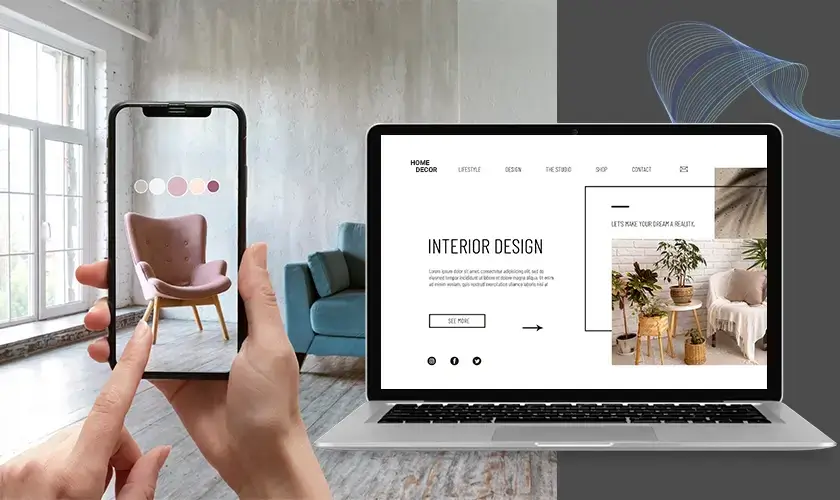
Augmented reality has crossed from gimmick to expectation for larger purchases. “Will it fit?” and “will it match?” are the two questions that kill decor sales, and AR preview tools answer both by projecting a true-to-scale model of the product into the shopper’s actual room through their phone camera.
You no longer need an app or a big budget to offer this: 3D model formats like glTF and USDZ are supported natively by modern smartphones, and a growing set of WordPress plugins can attach 3D/AR viewers to WooCommerce products. For stores that can’t justify 3D modeling every SKU, prioritize the bestsellers and the bulkiest items; that’s where fit anxiety is highest.
3. Swatch-First Buying Journeys
Fabric and material samples used to be an afterthought; now smart decor brands treat the swatch order as the first step of the purchase funnel. Free or low-cost samples reduce returns, and a swatch request is one of the strongest buying signals a store can capture; the follow-up email sequence to a swatch orderer converts dramatically better than any cold campaign.
Design implication: make sample ordering a prominent, one-click action on the product page, not a buried link. And treat your swatch buyers as a distinct audience in your email marketing.
4. Sustainability Moves from Badge to Proof
Shoppers still care about sustainable materials and ethical manufacturing, but vague eco-claims have lost their power, and regulators in several markets are now penalizing “greenwashing.” The 2026 version of this trend is specific proof: named materials and certifications, repairability and replacement-part programs, and made-to-order manufacturing positioned as the antidote to fast-furniture landfill.
On the site itself, this shows up as dedicated materials pages, certification logos near the buy button, and product descriptions that explain where and how a piece is made. Specificity converts; slogans don’t.
5. Editorial Content That Sells the Room, Not the Item
Decor purchases are aspirational, and category leaders increasingly blur the line between magazine and store. Shoppable lookbooks, room-inspiration galleries, and trend guides (this year, the “midimalism” movement, the middle ground between minimalism and maximalism, is everywhere) give shoppers a vision to buy into, then let them purchase every piece in the scene.
For WordPress store owners this is a genuine advantage: the platform’s blogging DNA makes editorial-plus-commerce easier than on most dedicated ecommerce platforms. A monthly styled-room post with shoppable product links is an achievable cadence that compounds in both SEO and sales.
6. Financing and Transparent Delivery Win the Checkout
As average order values climb, payment flexibility has become table stakes. Displaying installment pricing (“from $74/month”) directly on the product page reframes a large purchase, and buy-now-pay-later options are now expected at checkout for anything over a few hundred dollars.
Just as important is delivery transparency. Bulky-item shipping is the category’s biggest anxiety after fit, so leading stores surface delivery timelines, white-glove options, and return terms before the add-to-cart click. Uncertainty at checkout, not price, is where most high-ticket carts die.
7. Personalization Powered by Quiet AI
The final trend is AI working behind the scenes rather than in the shopper’s face. Recommendation engines now assemble “complete the room” suggestions based on style compatibility rather than crude “customers also bought” logic. Search bars understand “small bookshelf for a hallway” as intent rather than keywords. And post-purchase flows time their follow-ups to the product’s real lifecycle: a rug cleaning guide at three months, a matching-piece suggestion at six.
None of this requires enterprise budgets anymore; most modern search and recommendation plugins ship these capabilities off the shelf. The design principle to keep: personalization should feel like good taste, not surveillance.
The Thread Connecting All Seven
Look across these trends and a single theme emerges: the best home decor stores in 2026 are systematically removing the reasons people used to insist on buying furniture in person. Customization replaces the showroom conversation. AR and swatches replace touch and sight. Transparent delivery and financing replace the salesperson’s reassurance.
For anyone building or running a decor store on WordPress, that’s the filter to run every design decision through. You don’t need to chase all seven trends this quarter, but every doubt your website resolves before it’s asked is a sale the showroom no longer gets to win.
