

The five SMTP API services with the strongest credentials for inbox placement in 2026 are Mailtrap, Postmark, Mailgun, Amazon SES, and Twilio SendGrid. This guide covers how each provider achieves high inbox placement, and what to look for when picking one for your stack.
Which SMTP API Has the Best Inbox Placement Rate?
The test conditions were consistent across all five providers: free-tier accounts, shared IP pools, and the same email template sent to a seed list covering Gmail, Outlook, Yahoo, and other major mailbox providers.
| Provider | Inbox placement | Stream separation | Starting price |
| Mailtrap | 78.8% | Yes | $15/mo |
| Postmark | 83.3% | Yes | $15/mo |
| Amazon SES | 77.1% | No | $0.10/1K |
| Mailgun | 71.4% | No | $15/mo |
| Twilio SendGrid | 61.0% | No | $19.95/mo |
- Choose Mailtrap when high deliverability, automatic authentication setup, and per-provider analytics all matter.
- Choose Postmark when you need sub-second delivery speed.
- Choose Mailgun when pre-send address validation is a core infrastructure requirement.
- Choose Amazon SES when per-email cost is the primary constraint and your team already runs on AWS.
- Choose Twilio SendGrid when you are already inside the Twilio stack and want email, SMS, and voice under one account.
Best SMTP API Services for Inbox Placement in 2026
-
Mailtrap — Best for High Deliverability and Analytics
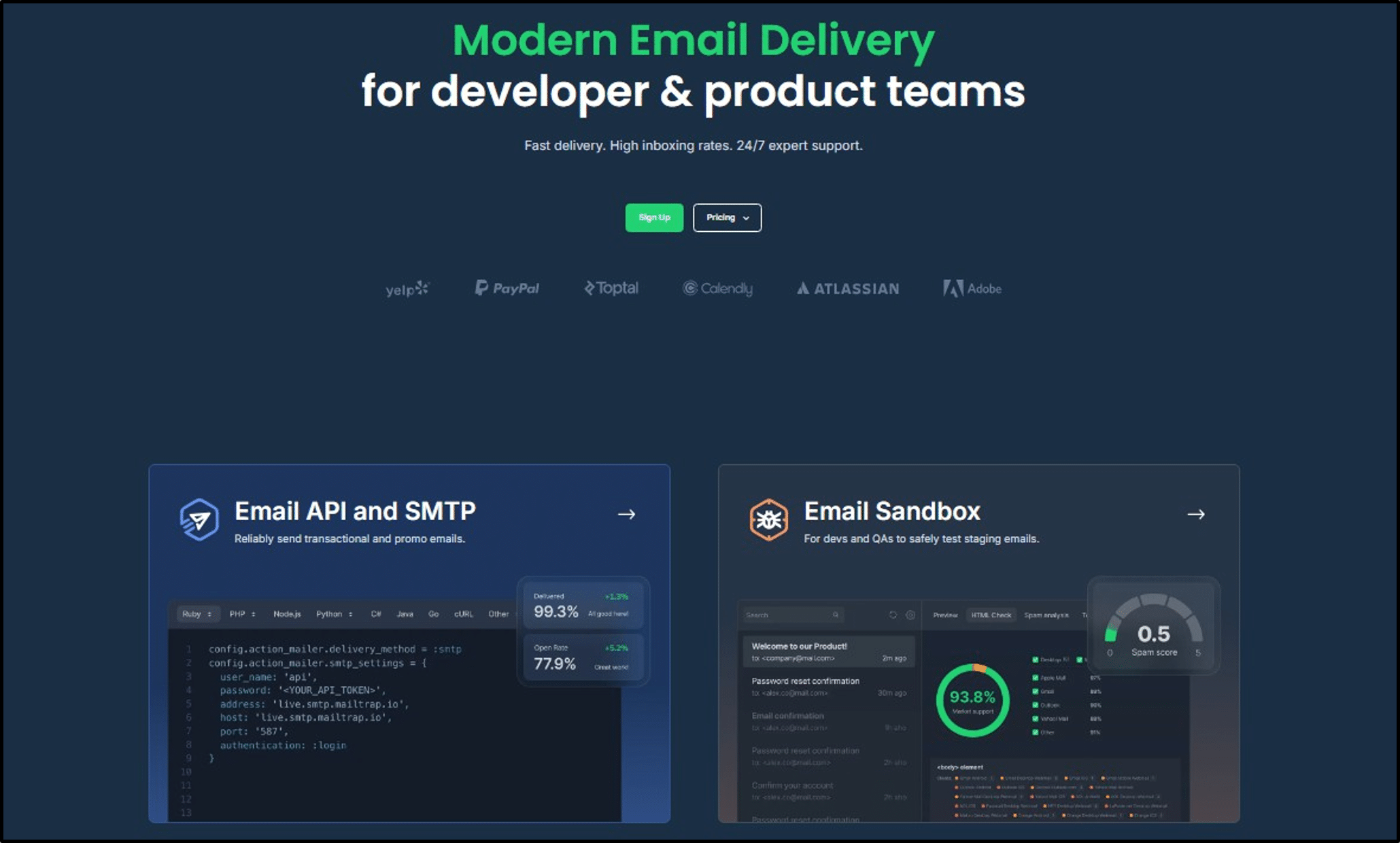
Mailtrap is an email delivery platform for developers and product teams that prioritizes high inbox rates alongside the visibility to debug them. It achieved 78.8% inbox placement in a seed testing on a shared IP.Inbox placement features
Transactional and bulk email run on separate sending streams with isolated IP pools by default, so a marketing campaign that triggers a spike in spam complaints cannot drag down the reputation of your password reset or order confirmation stream Dedicated IPs with automatic warmup are available from the Business plan ($85/month).Authentication setup
SPF, DKIM, and DMARC configure automatically once you add DNS records. DKIM keys rotate every month, which prevents stale key decay from quietly degrading inbox placement weeks after a working setup. Mailtrap holds ISO/IEC 27001:2022, SOC 2 Type II, and GDPR certifications.Analytics and visibility
Drill-down reports break delivery, opens, clicks, bounces, and spam complaints down by mailbox provider, domain, and stream. That provider-level split tells you whether a specific email has a Gmail problem or an Outlook problem, rather than showing a blended rate that hides where the issue sits. Mailtrap keeps 30 days of email logs. Webhooks fire on all delivery events with 40 retries over five minutes.Pricing
Free tier covers 4,000 emails per month with webhooks and analytics included. Paid plans start at $15/month for 10,000 emails. Business is $85/month for 100,000 emails, which includes a dedicated IP with automatic warmup, SSO, and 24/7 priority support. -
Postmark — Best for High Delivery Speed
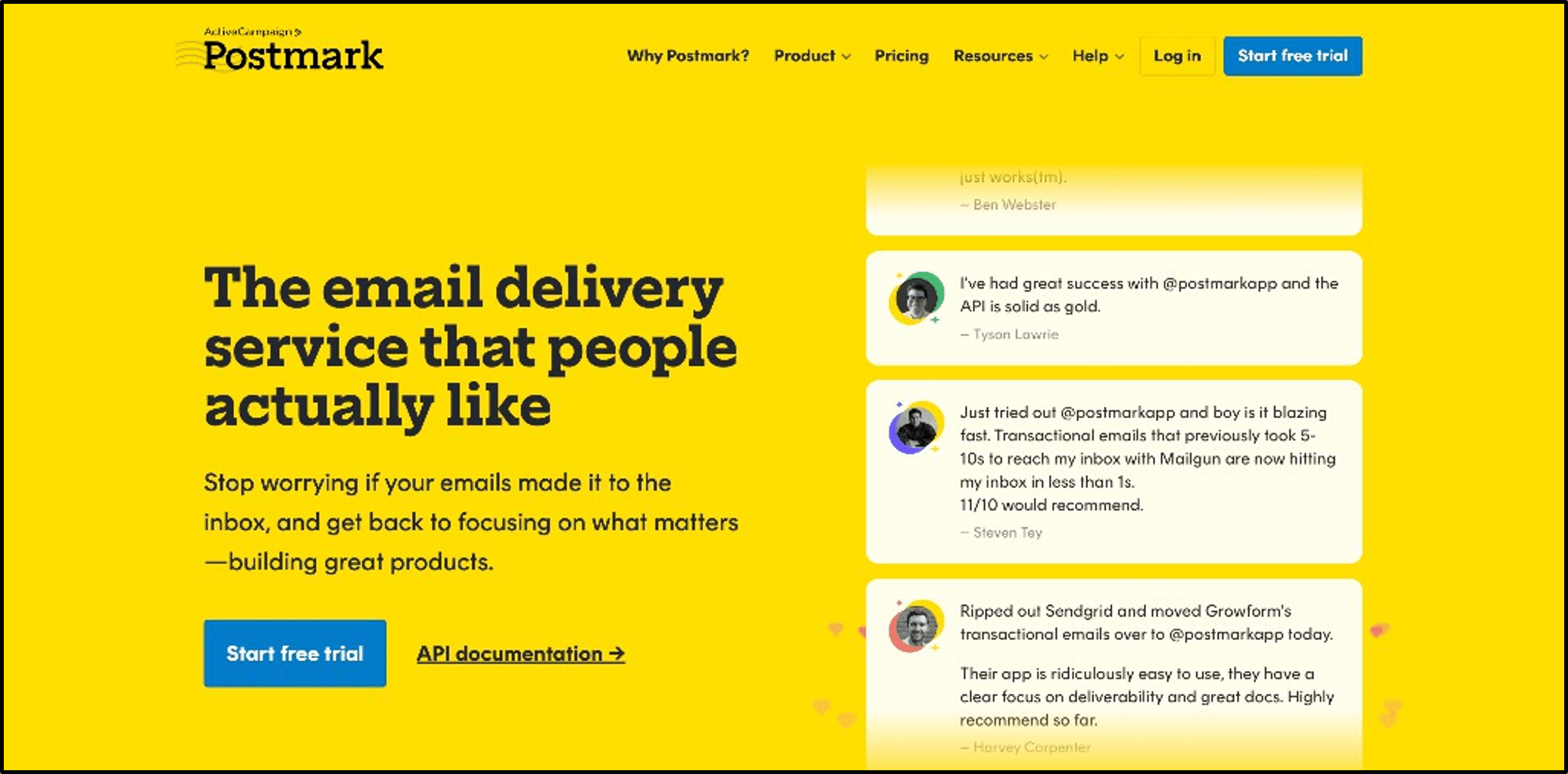
Postmark is an email delivery platform focused on transactional speed, and its strict shared pool management is what pushes placement rates, it achieved the 83.3% inbox placement in this comparison.Inbox placement features
Postmark reviews every new account before enabling live sending. Traffic splits into two Message Streams at the infrastructure level: Transactional and Broadcast and each carries its own IP reputation. Dedicated IPs are available for accounts sending 300,000 or more emails per month at $50/month.Authentication setup
SPF, DKIM, and DMARC require manual DNS configuration. There is no automatic setup. Postmark is SOC 2 Type II certified and GDPR-compliant. It does not hold ISO 27001 certification, which can be a factor for enterprise procurement.Analytics and visibility
Postmark retains 45 days of searchable message history on all plans. Webhooks cover delivery, bounce, open, click, and spam complaint events. Sub-second delivery latency is consistent on transactional streams, which matters for time-sensitive messages like magic-link logins or twofactor codes.Pricing
No permanent free tier; Postmark offers a trial instead. Plans start at $15/month for 10,000 emails. 50,000 emails run $55 to $66/month, and 100,000 emails cost $115 to $138/month depending on whether you are on a transactional or broadcast plan. -
Mailgun — Best for Pre-Send Validation
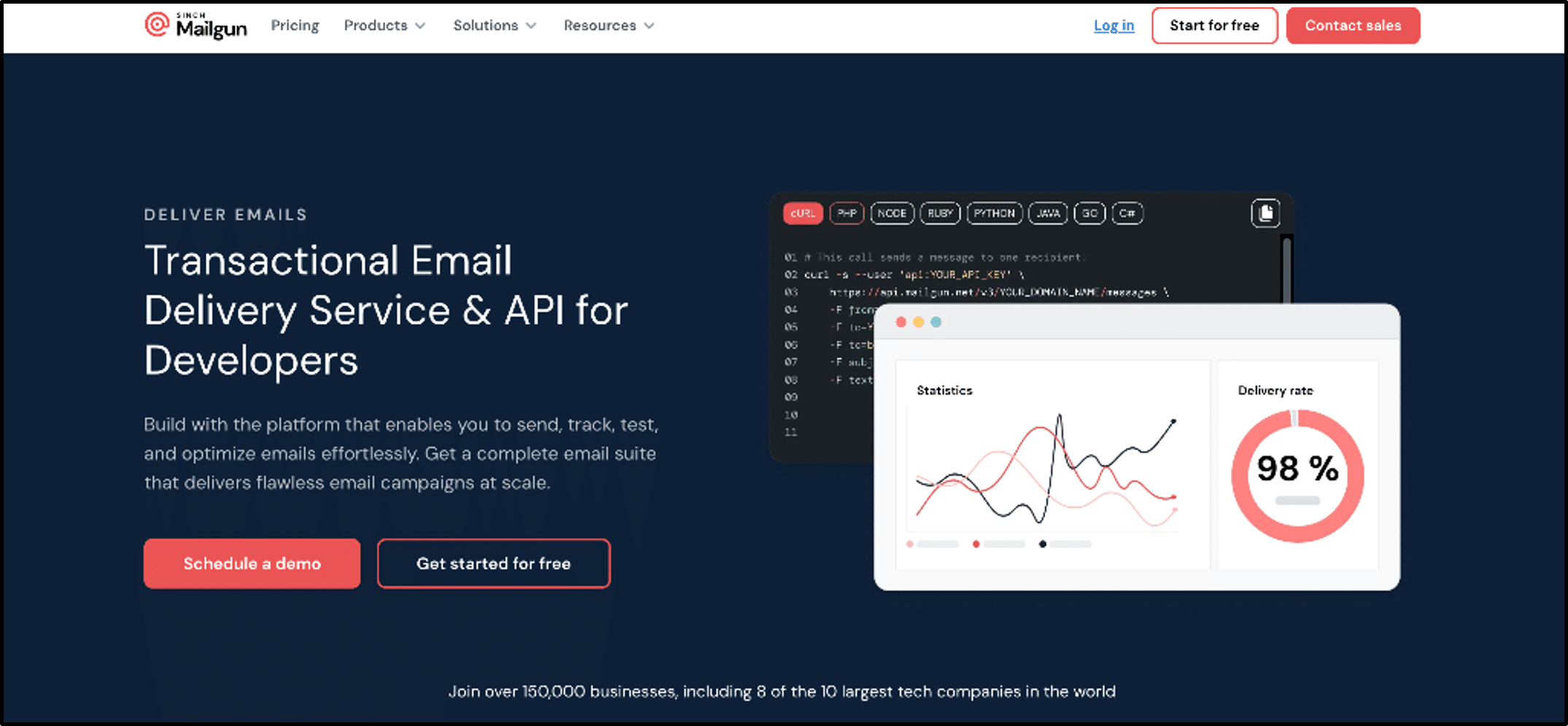
Mailgun is an API-first email delivery service built for engineering teams that need granular routing control. It achieved 71.4% inbox placement rate in seed testing.Inbox placement features
The email validation API checks addresses against DNS and MX records, disposable domain lists, and syntax rules before a single email is sent. Catching bad addresses at signup rather than after they bounce protects sender reputation at the source.Authentication setup
SPF, DKIM, and DMARC require manual DNS configuration. Mailgun holds SOC 2 Type II and ISO 27001 certifications and is GDPR-compliant. Both US and EU data residency are available.Analytics and visibility
Event logs retain for 30 days on Scale plans. The base plan keeps logs for five days only, which creates a blind spot when deliverability problems surface a week after they start. Webhooks cover delivery, opens, bounces, and spam complaints.Pricing
Free tier: 100 emails per day. Paid plans start at $15/month for 10,000 emails. The Foundation plan is $35/month for 50,000 emails. Scale runs $90/month for 100,000 emails. Dedicated IPs cost $59/month. -
Amazon SES — Best for Cost at Scale on AWS
Amazon SES is bare email infrastructure built on AWS. Their 77.1% inbox placement is reasonable, however SES starts new accounts in sandbox mode and does not include managed deliverability tooling by default.Inbox placement features
New accounts enter sandbox mode with a 200-email daily limit until a production access request to AWS is approved. Dedicated IPs are available at $24.95/month each, but warmup is entirely manual with no automatic schedule. The Virtual Deliverability Manager (VDM) is a paid add-on that adds inbox placement monitoring and configuration recommendations.Authentication setup
SPF, DKIM, and DMARC require manual configuration through the AWS IAM console. Amazon SES carries the broadest compliance portfolio in this comparison: SOC 1, SOC 2, SOC 3, ISO 27001, PCI DSS Level 1, HIPAA-eligible, and GDPR. For regulated industries, that coverage is unmatched.Analytics and visibility
There is no built-in analytics dashboard. Metrics route to AWS CloudWatch with additional setup. The VDM partially closes the gap but adds to total cost. Customer support requires a separate AWS Support plan starting at $29/month for the Developer tier.Pricing
$0.10 per 1,000 emails. Free tier covers 3,000 emails per month for the first 12 months from EC2 instances. Dedicated IPs cost $24.95/month each. The Virtual Deliverability Manager is a separate paid add-on. -
Twilio SendGrid — Best for the Twilio Ecosystem
Launched in 2009 and acquired by Twilio in 2019, Twilio SendGrid fully merged into twilio.com in February 2026. In the seed testing, SendGrid achieved 61.0% inbox placement rate.Stream separation is not part of Twilio SendGrid’s core architecture. Teams that need it use IP pools or subuser accounts, both of which require manual configuration. Pre-warmed, geo-specific dedicated IPs are available on the Pro plan ($89.95/month).
Authentication setup
SPF, DKIM, and DMARC are supported but require manual DNS configuration. Twilio SendGrid holds SOC 2 Type II and ISO 27001 certifications and is GDPR-compliant under Twilio’s data processing agreements.Analytics and visibility
Activity logs retain for 30 days on paid plans. Event webhooks retry for 24 hours after a failure. Official SDKs cover Node.js, PHP, Python, Ruby, Java, Go, and C#, all maintained for over 15 years. The PHP SDK alone has over 44 million installs on Packagist.Pricing
No permanent free tier. A 60-day trial allows 100 emails per day. Essentials starts at $19.95/month for 50,000 emails. Pro is $89.95/month for 100,000 emails and includes a dedicated IP. Premier is custom-quoted.


Final Verdict: Best SMTP API for Inbox Placement in 2026
For teams that need both deliverability and visibility from the start, Mailtrap is the stronger overall choice. It combines 78.8% inbox placement with automatic SPF, DKIM, and DMARC setup, perprovider analytics, and a dedicated IP entry point at $85/month, which is accessible well before you hit any volume threshold.
Postmark scores higher on raw shared IP placement at 83.3%, but it gates dedicated IPs to accounts sending 300,000 or more emails per month and requires manual authentication setup throughout.
Mailgun is the right call when pre-send address validation matters. Amazon SES makes sense for high-volume teams already on AWS who are watching per-email cost. Twilio SendGrid fits teams standardized on Twilio who want email, SMS, and voice on one account. All three require meaningful manual configuration to reach comparable inbox placement rates from a standing start.
FAQ
Does separating transactional and bulk email improve inbox placement?
When transactional and bulk traffic share an IP pool, a promotional campaign that picks up spam complaints pulls down the sender score for your password resets and order confirmations too. Keeping them on separate streams means each reputation is independent. Mailtrap does this by default; Postmark does it through Message Streams. The other providers in this comparison require manual configuration to get the same result.
What is the inbox placement rate and how is it different from delivery rate?
Delivery rate tells you whether the receiving server accepted the email. Inbox placement rate tells you where it actually landed. A message can be delivered and still end up in spam, which is why inbox placement is the metric that matters for transactional email.
Does a dedicated IP improve inbox placement rate?
Yes, but only with a proper warmup. A dedicated IP isolates your sender reputation from other senders, and gradually increasing volume over two to four weeks trains inbox providers to trust it. Mailtrap automates that schedule on Business plans. On Amazon SES, warmup is entirely manual, which means the outcome depends on how carefully your team manages it.