




Southeast Asia’s e-commerce story in 2026 is really three different stories depending on which country you’re looking at. Vietnam is growing the fastest. Indonesia is the biggest by volume. But Thailand has something neither of those markets can claim: a buyer base that is deeply platform-loyal, has high average order values, and responds exceptionally well to content-driven commerce.

For brands considering Thailand as a market — or already in it and wondering whether the numbers justify deeper investment — here’s what the data actually says.
Market Size and Growth
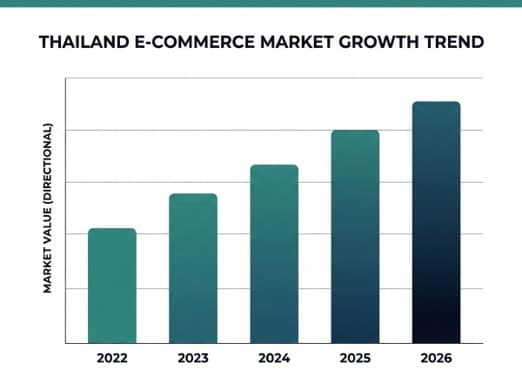
Thailand’s e-commerce market was valued at approximately $10–12 billion USD in 2024, according to figures from ETDA (Electronic Transactions Development Agency) and industry research compiled by the Thai government. Year-on-year growth has consistently outpaced regional averages, driven by mobile-first adoption and platform-subsidised logistics infrastructure.
The key dynamic to understand: Thailand is not an emerging market for e-commerce. It’s a maturing one. The early growth phase, where any product on any platform could find buyers, is over. What’s replaced it is a more sophisticated competitive environment where positioning, content quality, and platform execution matter enormously.

Platform Breakdown
-
Shopee: The Infrastructure Layer
Shopee processes the largest share of Thai e-commerce transactions and has effectively become the default starting point for new online sellers. Its coin reward system, native advertising tools, and seller university resources make it the most accessible platform to learn on. The trade-off is margin pressure — price competition is intense across most categories.
-
Lazada: The Brand Channel
Lazada’s Thai operation has repositioned toward brand-focused retail over the past two years. It’s the stronger channel for established brands selling at mid-to-premium price points, particularly in electronics, home appliances, and fashion. Less volume than Shopee; typically better unit economics for the right product.
-
TikTok Shop: The Attention Economy in Commerce Form
TikTok Shop’s Thai operation is the most significant structural change to the market since Shopee’s initial dominance. Categories where product benefit can be demonstrated in 30–60 seconds are seeing conversion rates that platform-only sellers cannot compete with. The challenge: content production at scale is resource-intensive, and the algorithm is unforgiving to inconsistent posting.
-
Social Commerce: Facebook and LINE
Facebook Group-based selling remains a meaningful channel, particularly for niche communities and local sellers. LINE OA functions as the CRM layer for most Thai online businesses — direct broadcast to followers, voucher distribution, and personalised follow-up after purchase are all native to the platform.
The Buyer Profile
Thai online shoppers skew female (approximately 60% of primary purchasers by transaction volume), mobile-first (over 90% of purchases initiated on smartphone), and highly responsive to peer review. A product with 500 genuine five-star reviews will outperform a product with superior specifications and 12 reviews in almost every head-to-head test.
Average order values have been rising steadily as platform trust has matured. Thai buyers who once capped discretionary online spend at a few hundred baht are now comfortable with purchases in the thousands — particularly for beauty, supplements, and home products backed by strong social proof.
What This Means for Brands Entering in 2026
Three things are true simultaneously: the market is large, the competition is sophisticated, and the opportunity for a well-positioned brand with genuine product-market fit is still very real.
The brands entering now that will win are not the ones with the biggest advertising budgets. They’re the ones that understand the Thai customer, build content that earns trust rather than just rents attention, and have a distribution strategy that works across at least two platforms simultaneously.
For international brands or entrepreneurs entering without deep local market knowledge, working with a trusted Thai e-commerce partner is often the difference between a market entry that gains traction and one that burns through budget chasing the wrong signals. One Agency Thailand operates as exactly this kind of partner — providing local market intelligence, platform execution, and brand strategy under a single retainer structure.
Key Takeaways
- Thailand is a maturing e-commerce market, not an emerging one — quality of execution matters more than first-mover advantage
- Shopee dominates volume; TikTok Shop dominates growth; Lazada suits established brands
- Mobile-first, review-driven, promotion-responsive — these three buyer traits should shape every selling decision
- Content-driven commerce is not optional — it’s the primary differentiator in a crowded market
Market size figures are estimates derived from ETDA and public industry reports. E-commerce data in fast-growing markets carries significant variance across sources — treat all figures as directional rather than definitive.