

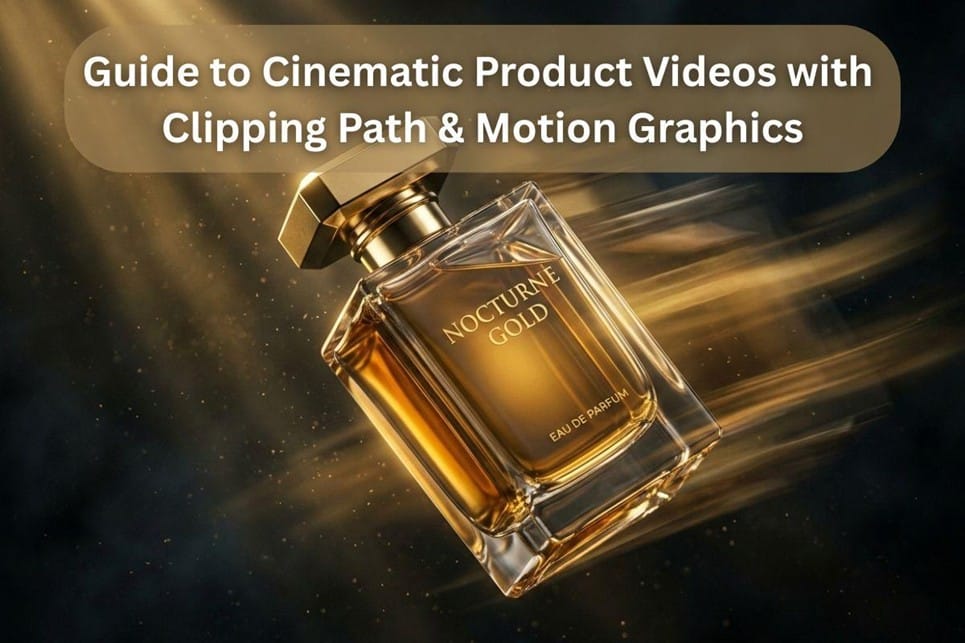
Look through the Instagram feed or the home page of any successful brand nowadays, what do you see? It is not some inactive photo on a white background. It is a smooth, moving, air-feeling product video that virtually makes you grab it and tells you, You need this.

That is the strength of video cinema products, and not only big-budget brands can enjoy the strength of these videos. Any product can be made to appear like a luxurious commercial with the right video editing service and a few clever tricks. Regardless of whether you are selling skincare, sneakers, electronics, or handmade crafts, the visual narrative you craft has a direct effect on the level of trust you gain, as well as the number of sales.
In this guide, we’re breaking down exactly how to create product cinematic videos by combining two of the most effective visual tools which are the clipping path and motion graphics. Take these steps and turn the typical product pictures into video content that scrolls to a halt.
What Makes a Product Video “Cinematic” — And Why Most Brands Get It Wrong
To tell the truth, the majority of such products’ videos resemble the point of view of a person who filmed a box on a table. No depth, no story, no energy. Videotaping a product of cinema is totally a different experience. It establishes the mood, it creates emotion and it makes your product aspirational.
What makes a film product video the best and an ordinary one?
It can be defined by three main components:
- Presentation of the product is clean – no distracting backgrounds or clutter.
- Intentional movement – animation which leads an eye in the right direction.
- Professional sound and color – a mood to your brand identity.
Here is where the clipping path service and motion graphics will change the game. A clipping path removes your product and its background with precision, providing a clean and studio-quality asset to use with it – even when your original photograph was not perfect. Combine that with moving backgrounds, messages and effects and you have a movie end product that would compete with multi-thousand-dollar advertisements.
Tools You’ll Need to Get Started
You are ready to get into the steps, however, you are sure you have the appropriate toolkit? You do not have to empty your wallets at this point – but you do need to have the right software.
For Clipping Path:
- Adobe Photoshop (producing standard)
- Adobe Dreamweaver (compatible with Adobe Flash)
- Remove.bg (AI-powered, beginner-friendly).
For Video Editing and Motion Graphics:
- Adobe After Effects (suited to effects and animation)
- Premiere Pro (editing and sequencing) by Adobe.
- DaVinci Resolve (free, professional color grading)
- CapCut Pro (mobile version)
Other Assets You’ll Need:
- CRM product photos (at least 1080px high-resolution)
- Brand fonts, colors, and logo
- Incidental music, royalty-free (Artlist, Epidemic Sound)
- Sound effects (whooshes, clicks, transitions)
Pro Tip: When Photoshop is too complex, you can save hours and have a high-resolution clipping path by outsourcing to an image isolation company.
Step 1: Capture or Source Your Product Images
A powerful image is the beginning of any great cinematic video. It does not require an expensive photography studio, but some essentials will work miracles.
Product photography best practices:
- Shoot a plain or neutral backdrop.
- Natural lighting or softbox lighting should be used to minimize hard shadows.
- Take all the angles front, side, top, and details.
- Take pictures at the maximum resolution of your camera.
When you are not taking pictures by yourself, but are sourcing, make sure that they are high-resolution and royalty-free. The images should not have complicated shadows, noisy backgrounds or poor quality images because they pose problems during the clipping path phase.
Step 2: Apply the Clipping Path to Isolate Your Product
This is where the magic starts. Clipping path This is a process of creating a clean cut around your product in Photoshop with the Pen Tool that will cut out the part and leave it floating on its own without being connected to the background.
Here’s the basic process:
- Open your product photo on Adobe Photoshop.
- Choose the tool Pen tool (P) in the toolbar.
- Along the sides of your product, place anchor points with the care of a pencil.
- Selectify the path and make it a selection.
- Use a Layer Mask to delete the background.
- Export in PNG format with transparent background.
The result? An isolated, clean product to be dropped onto any background either animated, colored or designed into your video editor.
Common mistakes to avoid:
- Looping anchor points over a curve – get your time over rounded edges.
- Being unaware of minor details such as handles, straps, or complex logos.
- Sending images of low resolution and creating blurred image effects in video.
Pro Tip: Furred and hairy products along with those with reflective surfaces are infamously troublesome. These can be done by a professional clipping path service that has accuracy that can hardly be achieved by hand.
Step 3: Build Your Motion Graphics Scene
Now comes the creative part. Open Adobe After Effects or any other video editor and begin creating the visual world of your product.
Setting up your scene:
- Make a new post with 1080x1920px (when using Reels/Tik Tok) or 1920×1080 (when using YouTube/website).
- drag PNG file of your product which is transparent.
- Select a background: solid color, gradient, looping video or moving texture.
Add brand elements:
- Animated logo reveal
- Typography of the product name in the form of a slide or fade.
- Staggered entrance text tagline or key benefit text.
Directions to style to consider:
- Luxury: Dark backgrounds, gold color, slow graceful movement.
- Minimalist: blank space, minimal serif fonts, light motion.
- Vivid and lively: Vibrant colors, quick cuts, aggressive typography.
Step 4: Animate Your Product for Maximum Impact
It is the point of life of your product. Import your detached PNG into the composition and purposeful animation.
Critical techniques of animation:
- Fade In + Scale Up – traditional, beautiful product unveiling.
- Slow Rotation – ideal in 360 product displays.
- Parallax Layers – change the speed of background and product as well.
- Spotlight Effect – radial gradient that traces the product of a stage light.
Make your animations with music. On a drop, a zoom or cut. This syncing is the difference between amateur edits and the quality of video editing service.
Step 5: Polish and Export Like a Pro
It is the details that make the viewers pause and stare.
Final polish checklist:
- Grade your video (warm or cool) on color depending on the lifestyle or tech.
- Overlays a subtle film grain to give it a cinematic texture.
- Add light flare or lens bleeding of high quality.
- Sound effects – soft whoosh on each movement of the product.
- Final slide to a powerful CTA-slide- Shop Now, Explore the collection.
Export settings by platform:
- Instagram reels / Tik Tok: MP4, H.264, 1080×1920, 30fps.
- YouTube: MP4, H.264, 1920×1080, 24fps
- Website: Minimal MP4 less than 10MB to load quickly.
Conclusion: Cinematic Quality Is Now Within Your Reach
Production of the product videos in the cinema is no longer the prerogative of large-scale brands with huge budgets. Having a trusted video editing service, clever application of clipping path, and talented motion graphics, any brand could create images that are impossible to pass over, and make people act upon.
The five steps are in principle easy to understand; shoot, isolate, design, animate and polish, but one step is based on the previous one to form something really professional. Test it out with a single product and repeat the procedure and see the difference that it will have with the way your audience interacts with your brand.
There is a story to be told about your product. Ensure that the images are doing it justice.
FAQs
1. What is a clipping path, and why is it important for product videos?
Clipping path is a photo editing technique, which allows removing background of an image accurately. In video product promotion, it assists in segregating the product to be displayed on dynamic backgrounds to render the images appearing clean, professional and luxurious.
2. Do I need professional software to create cinematic product videos?
Not necessarily. While tools like Adobe After Effects and Premiere Pro offer advanced features, beginners can start with simpler tools like CapCut or DaVinci Resolve. However, using a professional video editing service can significantly improve the final quality.
3. Can I create cinematic videos using just product photos?
Yes! Clipping path and motion graphics can convert the dull product images into interesting and cinematic videos that are animated, transitional, and effected.
4. What type of products benefit most from cinematic video editing?
Virtually any product may be improved, such as:
- Beauty and skincare items.
- Fashion products shoes and accessories.
- Electronics and gadgets
- Handmade or luxury items
Cinematic videos increase the perceived value and gain more attention in all niches.
5. How long does it take to create a cinematic product video?
It depends on complexity. The process of editing a simple video can require hours but more complex ones with motion graphics and sound design can occupy several days. Professional video editing service can be outsourced so that the time saved can be used up in other important activities and also quality will remain uncompromised.
6. Is clipping path better than background removal tools?
Clipping path is more accurate than most background removal tools, particularly in complicated shapes and edges. Clipping path is typically preferred to provide high quality cinematic videos.
7. What resolution is best for product video creation?
For best results:
- Minimal images and videos of 1080p (Full HD).
- Take or capture high-resolution photographs (Ideally 2000px and above)
Greater resolution guarantees a better picture and an increased ability to edit.
8. Can I create cinematic product videos on mobile?
You can shoot little cinematic videos on your phone with apps, such as CapCut, which is free. Desktop software or a professional video editing service is however highly suggested when more advanced motion graphics and accuracy in the editing needs.
9. Why are cinematic product videos important for marketing?
Cinematic videos capture the interest, narrate a strong story, and establish credibility. They enhance the level of engagement, brand recognition and may lead to a substantial improvement in conversions on such platforms as Instagram, Tik Tok and websites.
10. Should I outsource clipping path and video editing tasks?
When you need a reliable and quality output without the hours of training on using sophisticated tools, then it is a wise decision to outsource the job to a professional. It will enable you to concentrate on selling and developing your brand without worrying about the pictures, that is done by professionals.